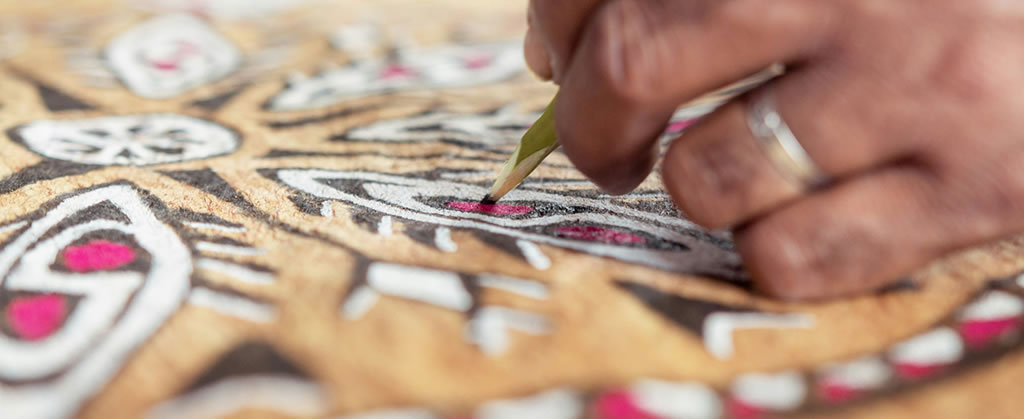
At a Glance: Aboriginal Art Symbols
| What they are | A visual language used mainly by Central and Western Desert artists to record Dreaming stories, Country and law |
| Are they universal? | No. Meaning varies by artist, community, language group and region |
| Most common symbols | Circles (waterholes/sites), U-shapes (people), wavy lines (water/travel), tracks (animals) |
| Why they’re not always literal | Some symbols carry restricted meaning not meant for public or outside audiences |
| Related technique | Often combined with dot painting to build up a composition |
What Are Aboriginal Art Symbols?
Aboriginal art symbols are a set of visual marks, mostly geometric, used to represent people, places, journeys and natural features in a painting. These symbols function less like a fixed alphabet and more like a flexible visual vocabulary: artists assign different meanings to the same symbol depending on the story they tell, their community, and the surrounding symbols.
This is an important distinction from written language. A U-shape doesn’t always mean the same thing; its meaning is set by context, much like a single word can shift meaning depending on the sentence around it. That’s also why two paintings using near-identical symbols can tell completely different stories.
Common Symbols and What They Typically Represent
The table below covers symbols that appear frequently across Central and Western Desert art. Treat it as a starting point for recognising shapes, not a literal translation key — regional and individual variation is the rule, not the exception.
| Symbol | Typical shape | Common meaning |
|---|---|---|
| Waterhole / site | Concentric circles | A waterhole, campsite, or significant place; often a Dreaming site |
| Person | U-shape | A seated person, viewed from above; tools placed beside it can indicate gender |
| Travel / journey | Straight or wavy connecting lines | Movement between sites, ancestral travel, or a Dreaming track |
| Water | Wavy or meandering lines | Rivers, rain, or flowing water |
| Meeting place | Larger circle, sometimes with radiating lines | A ceremony ground or gathering place for trade and storytelling |
| Animal tracks | Small paired marks or prints | The presence or movement of a specific animal, often linked to a food source |
| Digging stick / coolamon | Small linear or curved marks beside a U-shape | Commonly indicates the person depicted is a woman |
| Spear or weapon | Straight lines with a point | Hunting, ceremony, or (in some regions) conflict |
How Symbols Combine to Tell a Story
Individual symbols rarely stand alone. A painting typically layers several of them together: a circle for a waterhole, connected by lines to another circle representing the next site, with U-shapes marking where people gathered along the way. Read as a whole, the composition can function as a map of Country and an account of an ancestral journey at the same time.
This layering also serves a protective purpose. Some Dreaming stories include restricted content meant only for initiated members of a community. Artists can build a painting that reads as landscape and journey to a general audience, while a fuller, more specific meaning remains known only to those entitled to hold it.
Because layered symbols can carry restricted cultural knowledge, a public description of a painting’s symbols is often a partial reading, not the complete story. That’s intentional, and worth keeping in mind when interpreting a piece.
Colour as Part of the Symbol System
Colour works alongside shape to carry meaning, though — as with the symbols themselves — associations vary between artists and regions rather than following one fixed code.
| Colour | Traditional source | Common association |
|---|---|---|
| Red | Red ochre | Earth, blood, the desert landscape |
| Yellow | Yellow ochre | Sun, bush food, light |
| White | Pipeclay | Sky, ceremonial body paint, clouds |
| Black | Charcoal | Night, people, smoke |
Regional Differences in Symbol Use
| Region | Typical symbol use |
|---|---|
| Central Desert (Papunya, Utopia) | Dense use of circles, connecting lines and dot fields to map sites and Dreaming tracks |
| Western Desert (APY Lands) | Bold symbol clusters on a large scale, often depicting several sites within one composition |
| Arnhem Land | Fewer geometric symbols; figures and animals rendered through fine cross-hatching (rarrk) rather than dot-based symbol systems |
How to “Read” a Painting
- Look for repeated shapes first. Identify circles, U-shapes and connecting lines before anything else — they form the skeleton of most compositions.
- Note how shapes are grouped. A cluster of circles linked by lines usually indicates a journey between related sites.
- Check for provenance information. A certificate of authenticity or gallery label will often name the region, community, or specific Dreaming story, which changes how the symbols should be read. See our full authenticity buying guide for a detailed checklist.
- Accept that some meaning stays private. Even a detailed public description will unlikely tell the complete story — so we expect this, not a gap in the information provided.
Common Misconceptions
| Misconception | More accurate view |
|---|---|
| All Aboriginal art uses the same symbols | Symbol systems vary significantly by region and language group; some regions use very few geometric symbols at all |
| A symbol always means the same thing | Meaning depends on context, the artist, and the story being depicted |
| A public explanation covers the full meaning | Restricted or sacred content is often deliberately left out of public descriptions |
| Dot painting and symbol use are the same thing | Dots are a technique; symbols are the imagery. Many symbol-based works use flat colour rather than dots |
Frequently Asked Questions
Is there a single guide to what every symbol means?
No. Because meaning depends on artist, community and story, there’s no single universal key. Reliable sources — art centres, galleries, and artist statements — however will usually explain symbols in the context of the specific painting rather than as a general dictionary.
Why do some symbols look almost identical to letters or numbers?
It’s coincidental. The visual vocabulary developed independently of any written script, based on aerial views of camps, tracks, and landscape features.
Can I learn to identify symbols without cultural background?
You can learn to recognise common shapes (circles, U-shapes, lines) and their general associations, as covered above. However full interpretation of a specific painting, though, usually requires context from the artist or community it comes from.
Do symbols differ between Aboriginal art and Torres Strait Islander art?
Yes. Torres Strait Islander art has its own distinct visual traditions, often featuring marine imagery, carving and woven forms rather than the desert symbol system covered here.
Final Thoughts
Aboriginal art symbols work as a flexible, context-dependent visual language rather than a fixed code. Learning to recognise the most common shapes — circles, U-shapes, connecting lines — is a useful starting point. The artist, community, and story behind a specific painting usually determine its fuller meaning, some of which they never intend to share publicly.