At a Glance: Aboriginal Dot Painting
| What it is | An Aboriginal painting technique that builds an image from repeated dots rather than solid lines or blocks of colour |
| Where it started | Papunya, Northern Territory, in 1971 |
| Traditional materials | Natural ochre, charcoal and pipeclay on bark, sand or the body |
| Modern materials | Acrylic paint on canvas or board |
| Main purpose of the dots | To record Dreaming stories while concealing sacred detail from lay or outside viewers |
| Best known movement | Papunya Tula, founded by Central and Western Desert artists in the early 1970s |
What Is Aboriginal Dot Painting?
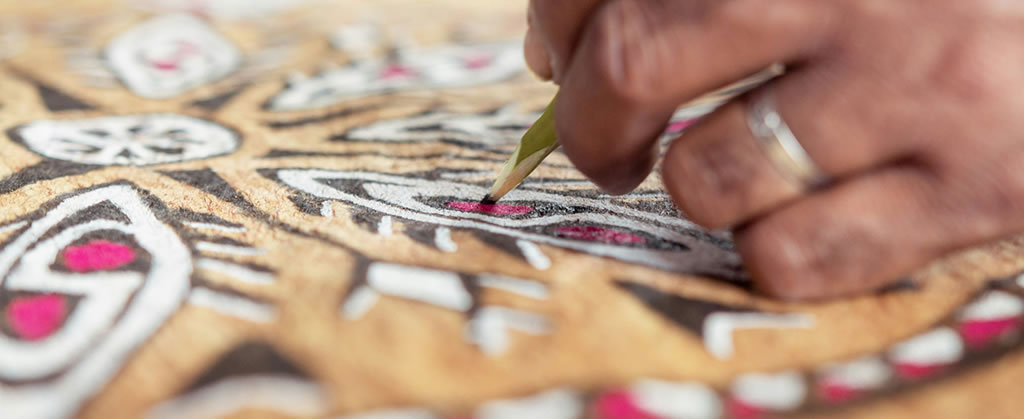
Aboriginal dot painting is a technique, not a single style. Artists build up an image entirely from dots of paint, applied with a brush handle, a matchstick or, today, a fine skewer, rather than painting continuous lines or filled shapes. The dots can sit close together to form dense fields of colour, or spread out to leave the underlying design visible between them.
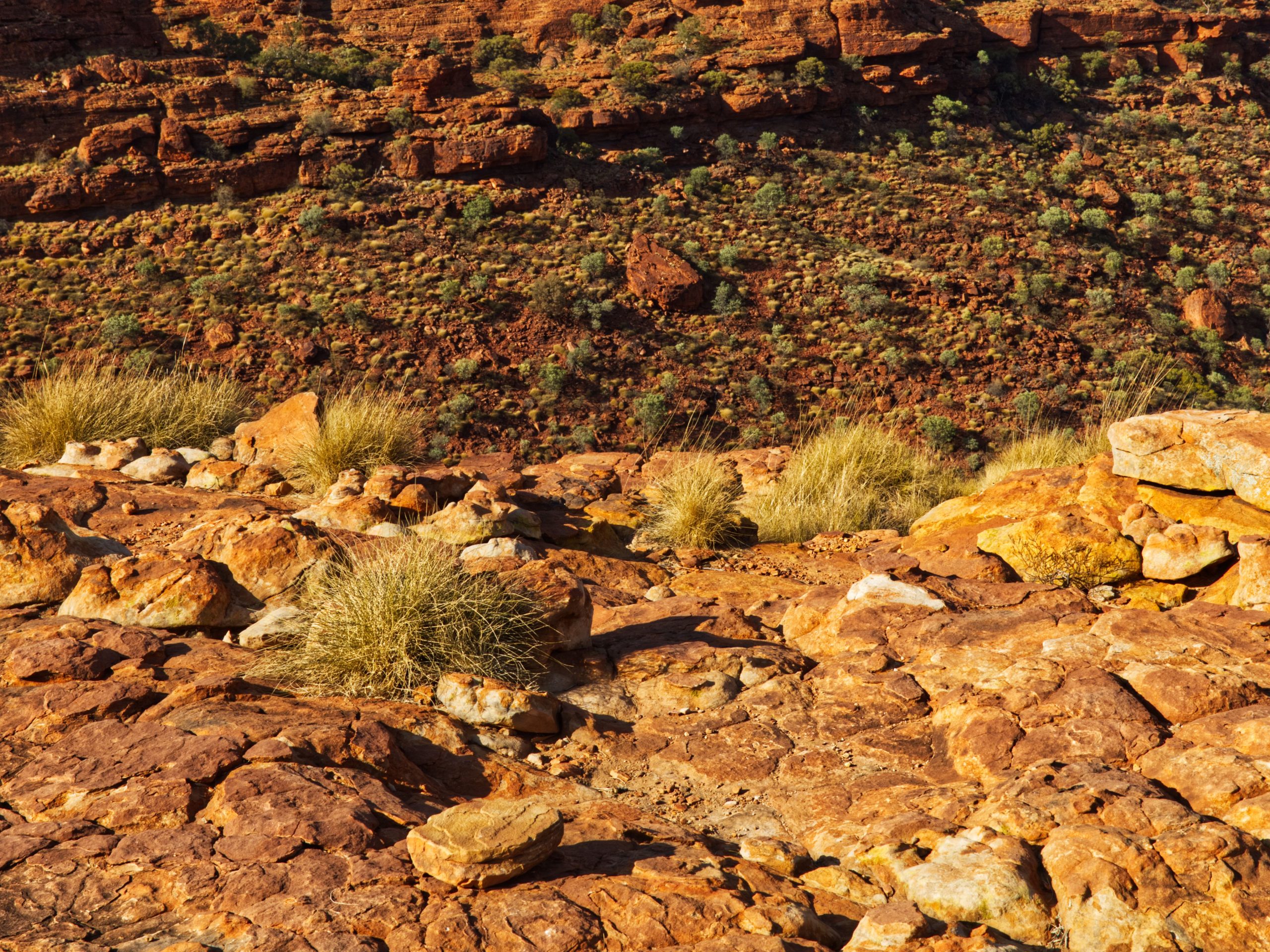
It’s a common misconception that all Aboriginal art is dot painting. Dot work is mainly associated with artists from the Central and Western Desert regions of the Northern Territory, South Australia and Western Australia. Communities in Arnhem Land, by contrast, are better known for rarrk (fine cross-hatching) on bark, while coastal and southeastern groups historically worked in carving, weaving and possum-skin cloaks. Dot painting is one thread in a much larger and older tradition, not the whole of it.
The History of Dot Painting
Dot painting as most people recognise it today is a relatively recent development, even though the underlying stories it depicts go back tens of thousands of years. Before the 1970s, the imagery now painted in acrylic on canvas was more commonly made in sand drawings, body paint and ceremonial ground designs, which were temporary by nature and rarely seen outside their community.
| Period | What happened |
|---|---|
| Pre-1971 | Sacred designs existed mainly as temporary sand drawings, body paint and ceremonial markings, not as permanent artworks for outside audiences |
| 1971 | Teacher Geoffrey Bardon encourages artists at Papunya, Northern Territory, to paint a mural and then continue on board and canvas, sparking the Papunya Tula movement |
| Early-to-mid 1970s | Artists such as Clifford Possum Tjapaltjarri and Kaapa Tjampitjinpa develop the dot technique partly to mask sacred content that shouldn’t be shown to the uninitiated |
| 1980s–1990s | Dot painting spreads to other Western and Central Desert communities and art centres, each developing its own regional variations |
| 2007 | Emily Kame Kngwarreye’s Earth’s Creation becomes the first work by an Indigenous Australian artist to sell for more than A$1 million |
| Today | Dot painting is produced and sold internationally, sitting alongside renewed efforts by art centres to protect authenticity and fair payment to artists |
Why Dots? The Reason Behind the Technique
The dot technique isn’t just decorative. Many of the designs painted by Western and Central Desert artists relate to Tjukurpa, or Dreaming: ancestral stories that map Country, law and ceremony. Some of that knowledge is restricted to initiated members of a community and isn’t meant to be seen by outsiders, children, or people of the wrong gender within the culture.
Layering dots over the underlying design is one way artists can share a painting publicly while keeping its most sensitive content obscured. The public can see the composition, the movement, the colour; the deeper meaning stays with those who are entitled to hold it. This is why the same painting can be read on more than one level: a landscape and a waterhole story to a general audience, and a specific ceremonial map to someone from the artist’s community.
Because dot paintings often encode restricted cultural knowledge, it’s worth remembering that a public explanation of a painting is rarely the full story the artist could tell. Respecting that boundary is part of engaging with the work in good faith.
Common Colours in Dot Painting and What They Often Represent
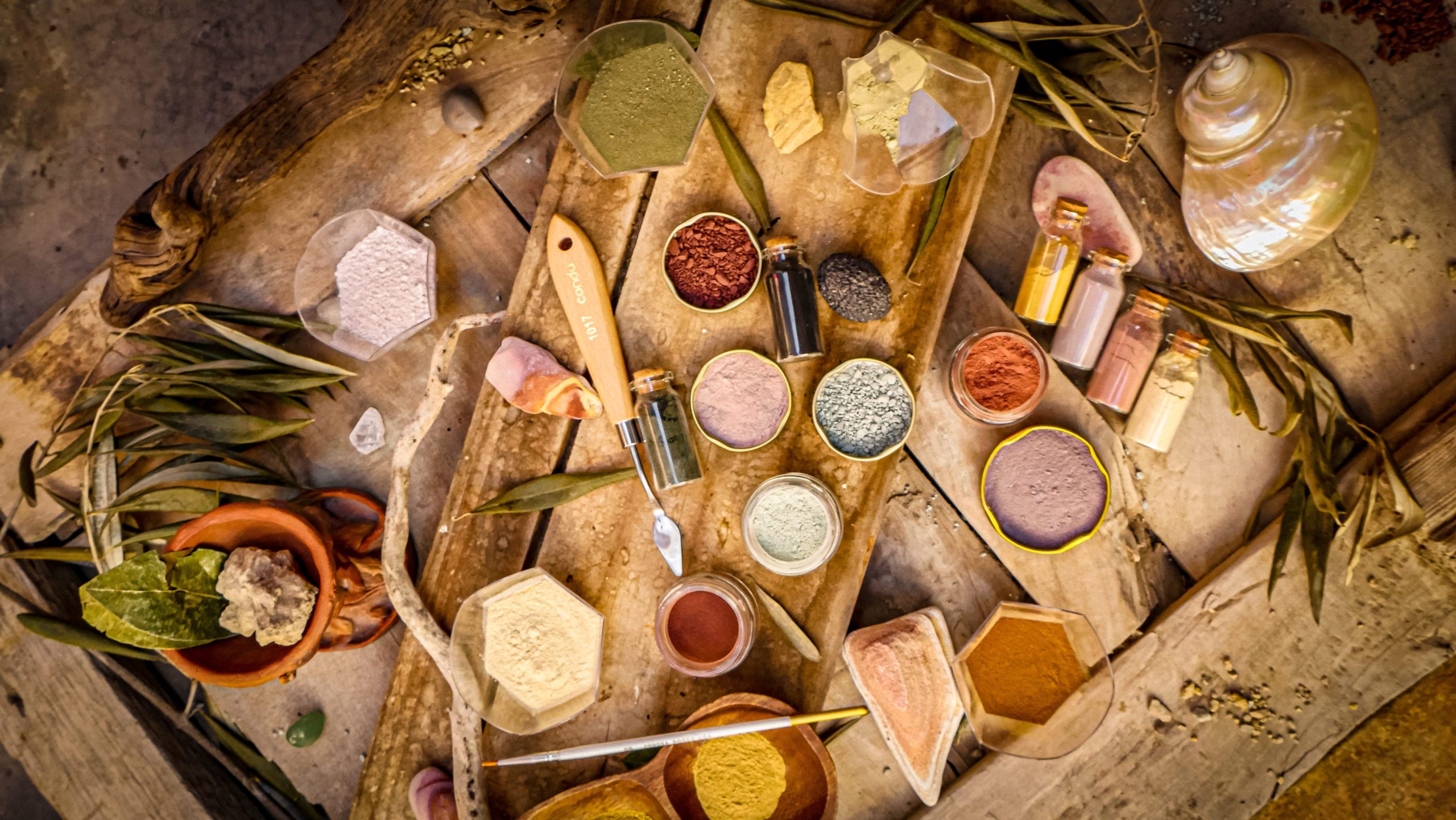
Artists and communities use colour in different ways, and meanings can vary between regions and individual artists. The table below provides a general guide rather than a universal set of rules.
.
| Colour | Traditional source | Commonly associated with |
|---|---|---|
| Red / red-brown | Red ochre | Earth, blood, the desert landscape |
| Yellow | Yellow ochre | Sun, bush foods, light |
| White | Pipeclay, chalk | Sky, clouds, ceremonial body paint |
| Black | Charcoal, manganese | Night, people, smoke |
| Blue / other bright tones | Not traditional; introduced with acrylic paint | Water, or purely a contemporary stylistic choice by the artist |
How Dot Paintings Come Together
The process has changed with the materials, but the underlying method has stayed similar since the 1970s.
- Artists lay out the underlying design first.
The artist blocks in the main composition, often the story’s key sites and pathways, in solid colour or outline. - Artists build up the dots in layers. Working from the background forward, the artist applies rows of dots, sometimes with several colours layered over one another so the earlier colour shows through at the edges.
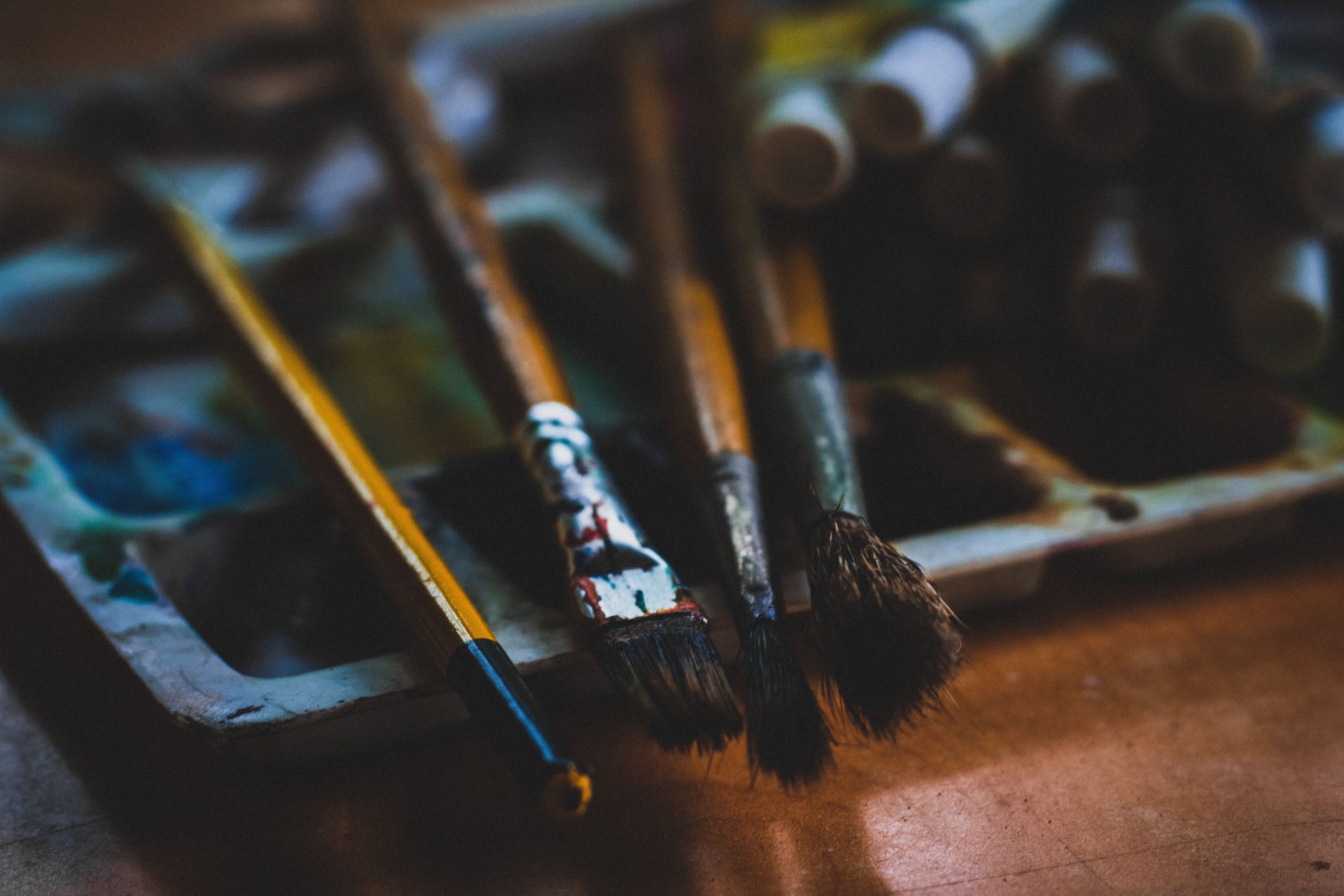
- Tools are simple. A brush handle, a cotton bud, a matchstick or a fine skewer is dipped in paint and dabbed onto the surface; the tool’s width controls the size of each dot.
- Artists use dot density to control what they hide and reveal. Tightly packed dots can obscure the design beneath almost completely; looser dotting lets more of the underlying story show through.
Traditional artists made pigments by grinding materials such as ochre, charcoal and pipeclay into a fine powder. They mixed these pigments with binders such as water, plant sap or, later, PVA glue. Since the 1970s, artists have mostly used acrylic paint on canvas or board for dot paintings made for sale. These materials are more durable and easier to transport, making them better suited to the commercial art market than the earlier ochre-and-bark works.
Regional Differences
| Region | Typical dot style | Notable feature |
|---|---|---|
| Central Desert (e.g. Papunya, Utopia) | Dense, fine dotting, often in concentric circles and connecting lines | Circles frequently represent waterholes or campsites; lines show travel between them |
| Western Desert (e.g. APY Lands) | Bold, larger-scale dotting with strong colour contrast | Vivid, often large canvases mapping Country and Tjukurpa |
| Utopia region | Looser, more gestural dotting, sometimes combined with linear “awelye” body-paint patterns | Associated with artists such as Emily Kame Kngwarreye, who moved between dot work and freer linear styles |
Well-Known Examples
A few reference points help show the range of the technique:
- Clifford Possum Tjapaltjarri – one of the founding Papunya Tula artists, known for intricate, large-scale dot compositions mapping ancestral travel.
- Emily Kame Kngwarreye – began painting in her late seventies and became one of the most collected Aboriginal artists internationally; her 1994 work Earth’s Creation sold for more than A$1 million in 2007.
- Papunya Tula Artists (the art centre) – still operating today, it represents artists from the community where the movement began and is a useful reference point for what an established, artist-owned art centre looks like.
How to Recognise Authentic Dot Painting Art
For a full walkthrough, see our complete guide to buying authentic Aboriginal art.
Mass-produced, non-Indigenous-made “Aboriginal style” dot art is common in tourist shops and online marketplaces, and it doesn’t return any income to Aboriginal artists or communities. A few practical checks:
| Check | What to look for |
|---|---|
| Certificate of authenticity | Should name the artist, community or art centre, and describe the story, not just the title |
| Source | A recognised art centre, gallery, or dealer who discloses where the work came from |
| Consistency of dots | Hand-applied dots vary slightly in size and spacing; mass-produced prints or stencilled copies are usually perfectly uniform |
| Price versus scale | Extremely cheap “hand-painted” canvases at tourist-shop prices are a red flag |
Frequently Asked Questions
Is dot painting the same as Aboriginal art in general?
No.
Central and Western Desert artists mainly use dot painting as one of their artistic techniques. Other Aboriginal art traditions include bark painting and cross-hatching in Arnhem Land, wood carving, weaving and rock art, among others.
How old is dot painting?
The technique emerged in its modern form in 1971. However, it draws on ancient sand and body-painting traditions that have been practised for tens of thousands of years.
Why do some dot paintings look “blurred” or hazy?
That’s usually intentional. Dense, overlapping dots are often used specifically to soften or obscure the underlying design, which can carry restricted cultural meaning.
What paint do contemporary artists use?
Most dot paintings created today use acrylic paint on canvas or board. Some artists continue to work with ochre and other natural pigments, particularly when creating pieces that stay closer to traditional practices.
Final Thoughts
Dot painting is a specific, comparatively modern technique with roots in a much older visual language. Knowing its history, from the 1971 Papunya mural to today’s global art market, helps us better appreciate what a painting shows. It also makes it easier to understand the significance of the artwork. Finally, it helps you buy from sources that genuinely support the artists behind it.

